When strong crops yield less: heat stress and rice sterility
CY26 Annual Summary | Focus Site Case Study
During the CY26 season, rice crops across the Murray Valley (MV) and Murrumbidgee Irrigation Area (MIA) showed uniform, strong vegetative growth. Average crop N Index peaked at levels similar to the record CY25 season and accumulated degree days were also comparable – both key indicators of yield potential. However, final yields were one to two tonnes lower than expected, suggesting that yield loss occurred during the reproductive phase rather than biomass accumulation.
Relationship between heat stress and sterility
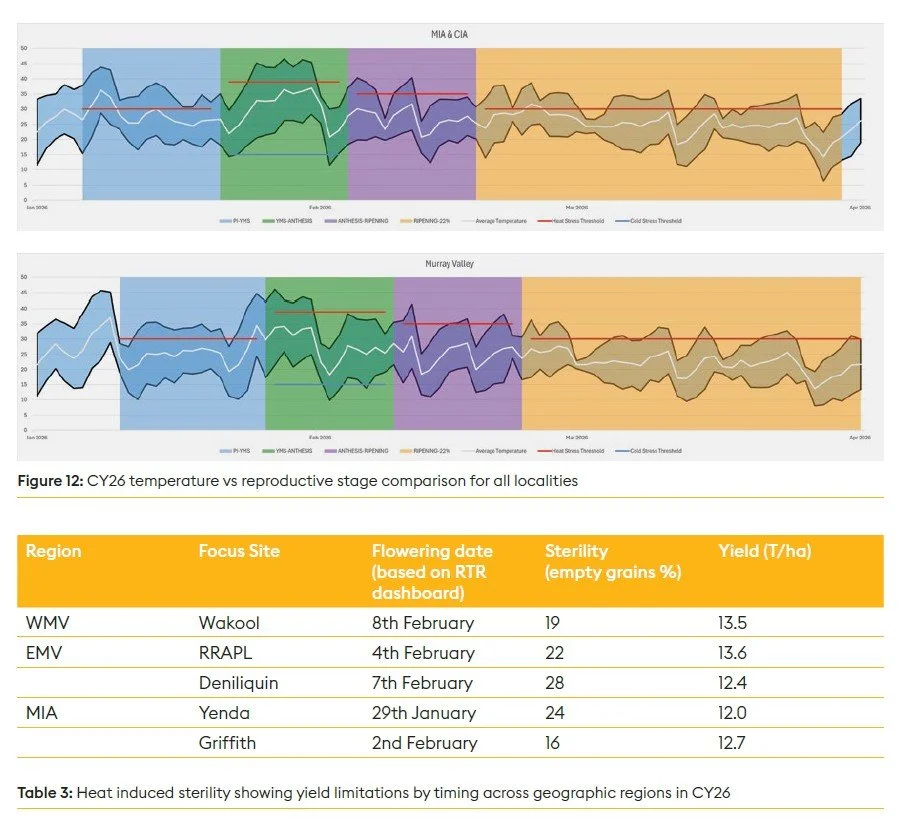
All regions experienced elevated temperatures during key reproductive stages, including panicle initiation (PI), microspore and flowering. In late January, temperatures exceeded 40°C for a week, peaking at 47°C.
This heat event aligned with late microspore to early flowering in the MIA and Coleambally Irrigation Area (CIA), and with microspore in the MV.
Figure 12 shows minimum, maximum and average temperatures for each rice-growing region and reproductive stages are shown for Matilda (V071). PI, microspore and flowering are shown in blue, green and purple, respectively. Red and blue lines indicate heat and cold stress thresholds during reproductive stages, including microspore. Grain filling and ripening are shown in orange.
Heat stress can result in increased sterility and reduced yield at various reproductive stages.
→ At PI: reduces panicle number and size
→ At microspore: impairs pollen development
→ At flowering: disrupts fertilisation
This pattern was consistent across all seven Focus Sites. Flowering dates from the Rice Management Dashboard closely aligned with the heat event, with sterility ranging from 16% to 28%.
This consistency across regions highlights the widespread impact of the heat event, despite differences in management and location.
Field data showed sterility was a major yield constraint across all regions, prompting further investigation into its drivers and implications.
Discussion
Heat stress during critical reproductive stages, particularly microspore and flowering, was the primary driver of sterility and reduced yield potential in CY26. Extreme heat at this stage can be likened to a frost event at flowering for a winter crop. To put it in perspective, long term (retired) rice research agronomist Brian Dunn noted that he has not observed a heat event of this impact in over 40 years of research.
Unfortunately, growers had limited ability to mitigate this event. Unlike cold stress, there is no evidence that deep water protects the crop from heat stress (especially at these extremes).
However, timing is still critical to consistently maximising both yield and quality over time. The key message remains the same:
→ Manage the crop to reach PI the first week of January;
→ Establish strong foundational plant population, manage weed control and pre-plant nutrition (phosphorus, sulphur and zinc); and
→ Use nitrogen strategically and efficiently to maximise yield and profitability.