
Understanding soil constraints: pH and the rice farming system
CY26 Annual Summary | Focus Site Case Study
Soil acidification is a well-known issue in many agricultural systems but in traditional flooded rice, soil pH has not been a concern because flooded conditions neutralise the soil solution.
However, with more than 80% of the crop now drill sown, the critical first six to eight weeks of crop development are exposed to such soil conditions, bringing acidification into sharper focus.
Every product removed from any farming system, such as grain and straw, adds to soil acidity. As production increases and becomes more intensive, soil pH declines more rapidly. This can alter nutrient availability as well as directly limit crop growth due to increased aluminium levels. Understanding these changes and their impact on crop performance is critical to maintaining productivity in modern rice systems.
Implementation
At a Focus Site in the Eastern Murray Valley, an aerial-sown paddock has outyielded an adjacent drill sown paddock by ~1.7 T/ha over two consecutive seasons. This is despite other nearby drill sown paddocks achieving the highest regional yields.
Following CY25, phosphorus availability and row spacing were considered likely drivers of this yield difference. These were tested in CY26 by increasing phosphorus (130–200 kg/ha MAP) and narrowing row spacing (10" to 6"). However, the aerial paddock again outyielded the drill sown by 1.7 T/ha.
Interestingly, another nearby drill-sown paddock under similar management achieved yields comparable to the aerial-sown treatment.
However, differences in paddock history, including the preceding vetch crop compared with the repeat-rice history of the Focus Site, make direct comparisons difficult. These results suggest that factors beyond establishment method alone, including soil pH and rotational history, may have influenced yield outcomes.
Results and outcomes
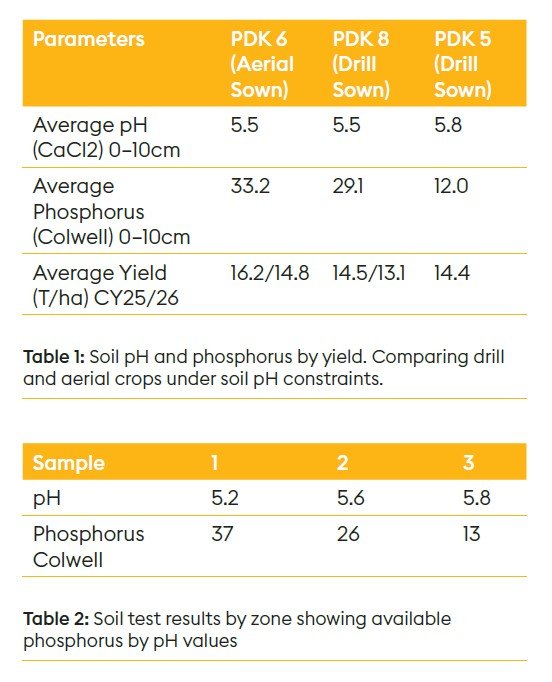
Table 1 summarises the soil test results for pH and phosphorus by yield across the three blocks. The aerial block (Pdk 6) where pH is neutralised by flooding, consistently outyields the drill sown block (Pdk 8) with a similar pH, where the rice seedlings are more exposed to soil acidity. Conversely, the higher pH (Pdk 5) has a higher yield closer to the aerial sown block, giving an indication that pH may be playing a bigger role than credited for in rice yield. While the theory stacks up, this is a hypothesis that will need to be tested next season.
It’s important to note that the heat stress crops experienced in CY26 caused up to 27% sterility across all crops and accounts for much of the difference in yield between seasons in Pdk 6 and 8.
Where soil tests are taken across a field, it is a commonly observed trend (as illustrated in Table 1), that the higher the pH (less acidic), the lower the available phosphorus (Pdk 5 with a phosphorus level of 12.0 compared to Pdk 6 at 33.2).
If we look at this in more detail, Table 2 shows three individual samples taken from Pdk 8. The phosphorus was measured from the same sample point as the pH (rather than amalgamated, average results across the paddock).
This paddock has been intensively cropped with consistent fertiliser application over time. Results indicate that lower pH areas have higher available phosphorus, likely due to reduced yields and lower nutrient removal. In contrast, higher pH areas achieve better yields which therefore draw down more phosphorus.
These are subtle but common trends that develop gradually over time, often resulting in slow yield declines that only become apparent after several seasons. As system intensity increases, so does the rate of acidification. Regular soil testing to monitor pH trends is critical to prevent small year-on-year yield losses from accumulating over time, especially as the inputs needed continue to increase just to maintain the same or even declining yield.
Key learnings
→ Soil acidity is a hidden yield constraint: declining pH can limit crop performance even with increased fertiliser inputs.
→ Soil health is increasingly important: with more drill sowing, underlying constraints like acidification are becoming more influential on crop yield and whole-of-system performance.
→ Early monitoring supports better management: regular soil testing helps identify issues early and guides corrective action.