
CY25 vs CY26: quality won or lost in timing
CY26 Annual Summary | Case Study
CY26 will be remembered as the polar opposite of CY25, particularly in terms of grain quality. CY25 was one of the poorest years for quality, with high levels of cracked grain and reduced whole grain yield, whereas CY26 stands out as one of the best quality years on record.
So, what drove this contrast? Why did these differences occur and is there a clear takeaway from comparing the two seasons that can help improve future yield and quality outcomes?
While this topic could easily fill entire scientific papers, the key differences between the two seasons can largely be explained by two factors: timing and weather. Together, these had a major influence on both yield and grain quality.
CY25: the perfect season – almost
CY25 was characterised by excellent preparation and establishment conditions, followed by
near-perfect growing weather that delivered an exceptionally high-yielding season. This included a record Matilda yield of 17.4 T/ha and an overall Matilda average of 12.5 T/ha. However, it was evident before Christmas that many crops were developing too early. This raised concerns about a high risk of quality issues, driven by the likelihood of heat during grain fill and an early harvest accompanied by rapid grain dry down.
Heat during grain fill affects the formation of starch within the grain. With high temperatures, the starch that gives the rice grain its strong crystalline structure does not form properly, weakening grain integrity. This was reflected in grain harvested at 18% moisture with a Quality Score (QS) of 8.0, which dropped to 5.5 after just 5 mm of rain. The grain integrity was not there in the first place.
Rapid dry down from maturity (starting at around 24% grain moisture) further reduced the optimal harvest window (18–22%). As a result, many crops were harvested at moisture levels below 15%, with a significant delay between the predicted 22% moisture timing and actual harvest. Intermittent rainfall events, often followed by hot conditions, re-wet already dry grain further increasing the risk of cracking.
These impacts were compounded by the fact that crops were 10–14 days earlier than optimal. The majority reached panicle initiation (PI) prior to the New Year, with many occurring before Christmas. This meant that crops reached critical growth stages (PI, microspore, flowering, grain maturity, dry down and harvest) during adverse conditions. This had a cumulative effect on poor grain quality. It is worth noting that many ‘later’ (that is on-time) crops maintained a quality score of 8–8.5, it was the long tail of poor quality scores that drove the average down to 7.2.
CY26: the almost perfect season
As the season analysis shows, CY26 began with a cooler, slower start that delayed establishment. However, heat around Christmas, supported excellent biomass accumulation and yield potential, comparable to CY25. Crop timing was also excellent, with most crops reaching PI in early January. This positioned the crop well to achieve both high yield and grain quality. While the total cropped area was smaller, making it easier to align sowing within the optimal window, there are still valuable lessons to take from this season.
Between 25th and 31st January, the region experienced seven consecutive days of extreme heat, with temperatures in the mid-40s and a peak of almost 47°C. During this period, early crops were at flowering, while most were at the young microspore stage. Extensive research shows that both stages are highly sensitive to heat, with temperatures above the high 30s disrupting pollen development and fertilisation, leading to floret sterility (see Figure 14).
This heat event had a direct impact on yield. From 117 one-metre square quadrant samples collected across the region, sterility in Matilda averaged between 15–30% (see page 18), compared with a typical value of less than 5%. Given the sensitivity of crops to excessive heat during microspore and flowering, not many crops escaped some level of sterility. Despite this, yields remained above the five-year average, with Matilda averaging 12.25 T/ ha. Without this period of extreme heat and if we calculate what yields are likely to have been at around 5% sterility, CY26 was certainly “the one that got away”.
In contrast, grain quality in CY26 was outstanding.
The overall quality result averaged 9.5, making it one of the best years on record. Timing was a key driver, with crops in CY26 developing 10–14 days later (and closer to optimal) than in CY25.
While temperatures during grain fill were broadly similar between seasons, the earlier timing of CY25 exposed crops to a prolonged heat period compared to CY26. In CY26, slightly higher humidity, combined with improved timing, helped extend the optimal harvest window. As a result, the lag between predicted 22% moisture and actual harvest was minimal, with average delivery moisture around 20%.
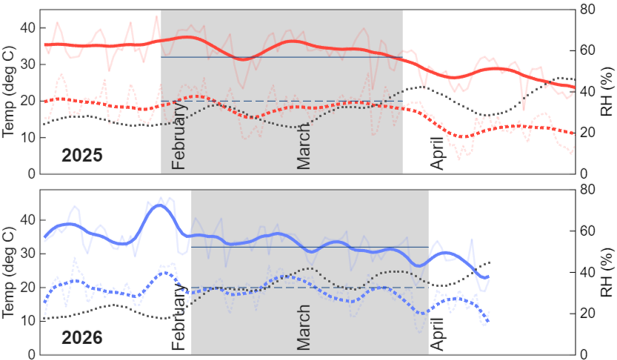
Figure 14: Temperature, humidity and timing of CY25 compared to CY26. The shaded area is the time period between 50% of crops flowering to 50% reaching 22% moisture. Note the 10–14 days earlier CY25 crop and the heat ‘bulge’ for the CY26 crop. Solid coloured lines are maximum temperatures, while dashed coloured lines are minimum temperatures. Dashed black lines are relative humidity. Ref Dr Mark Talbot (AGS)
Key learnings
→ Timing is the foundation of both yield and quality: getting crops to PI in early January maximises alignment with favourable conditions during sensitive growth stages. Crops that develop 10–14 days too early are more exposed to heat during grain fill and rapid dry down, increasing the risk of grain cracking and reduced quality.
→ Yield potential can still be high despite heat stress: CY26 demonstrated that even with elevated sterility (15–30%), strong biomass and good timing maintained above-average yields – but with unrealised potential.
→ Control the controllables: while weather extremes cannot be controlled, crop timing and establishment decisions heavily influence outcomes.