
Breaking down yield: where does it really come from?
Rice yield is determined by a combination of soil conditions, water availability, field layout, crop genetics, seasonal factors and management practices.
Yield is built step-by-step, starting with plant establishment and tillering, then moving through panicle development, grain set and finally grain filling. Key indicators include plant population, crop biomass production, Harvest Index (grain yield divided by total biomass), number of tillers, panicle size, number of grains per panicle, how many of those grains fill and grain weight.
Seasonal conditions (especially temperature) can have a big impact with hot or cold weather at sensitive stages able to cause sterility, leading to fewer filled grains and lower yield. At the same time, good management plays a major role and getting the timing, irrigation management and nutrition right sets the crop up to reach its potential.
Tracking crop performance
Following some outstanding crops in CY25, Rice Extension set out to better understand the foundations of this yield potential. The aim was
to unpack the key drivers behind high-performing crops and identify how these can be consistently achieved across different seasons and production systems.
To investigate this, the Rice Extension team monitored seven Focus Sites across the rice-growing region each with different rotations, soils conditions and timing. Assessments included plant population, early vigour, key growth stages (panicle initiation (PI), flowering and grain maturity) and nitrogen uptake at PI. At each site, one-metre square quadrant samples were collected to measure the key yield factors
Yield components and outcomes
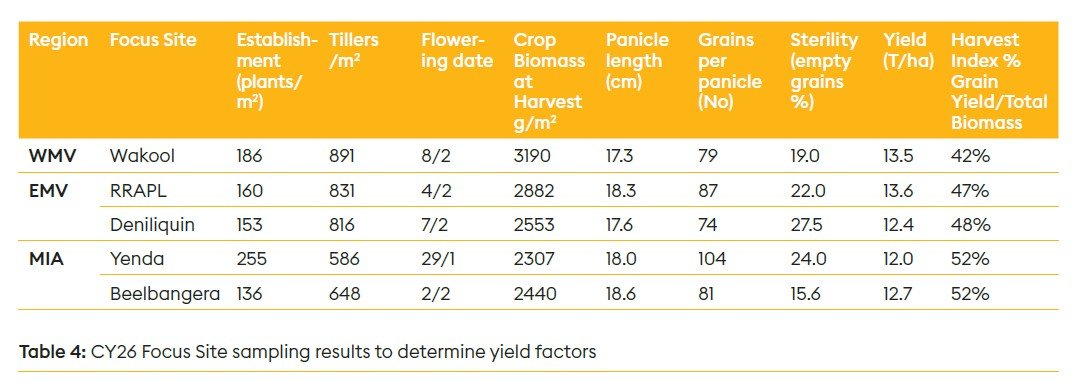
Table 4 summarises the drivers that determine yield. These measurements were taken by Rice Extension and are averages of multiple one-metre square quadrant cuts at each site taken throughout the season. Based on this data, below is an explanation of the interactions of these measurements and their impact on yield.
Establishment and early vigour
Strong, even crop establishment is a critical driver of yield as it supports optimal plant populations, strong root development, uniform growth and the production of productive tillers.
However, the relationship between establishment and yield has limits. Long term research has consistently shown that optimal populations range between 100-200 plants/m². Above this threshold, plants compete with each other, produce fewer tillers and smaller panicles, which can ultimately limit yield. This was evident at the Yenda site, which had the highest establishment (~255 and up to 320 plants/m²) but a lower tiller number (586), resulting in a yield of 12 T/ha.
Crop biomass and Harvest Index
One of the key drivers of yield, crop biomass provides the energy to fill the panicle. The crop needs a critical biomass to maximise yield.
However, if over-fertilised, especially during the mid-vegetative phase, the plant can put the energy into biomass production instead of yield.
In Table 4, the Yenda site with the lowest biomass had a higher Harvest Index. At 52%, this is a high yield for the amount of biomass and more biomass would likely have created bigger yield. This crop was limited by its tiller count/m² (and biomass production).
Where the Harvest Index is at 42% (as in the Wakool site), biomass was not a limiting factor. In fact, in this instance with good tiller count, it is likely this yield could have been achieved with less nitrogen and potentially slightly earlier flowering date.
Panicle length
Panicle length can be an important trait associated with grains per panicle and overall yield potential. Longer panicles typically have more primary and secondary branches, resulting in a higher number of grains per panicle.
In this season, however, panicle length showed only minor variation across sites and no clear relationship to yield. This suggests that in CY26, panicle length was not a major driver of yield difference.
Grain per panicle x panicles/m2
Grains per metre square is the overall key driver of yield and is a function of all the other components combined. Optimising tiller number, panicle length and grains per panicle is the aim, which directly depends on plant population and crop biomass.
These factors are influenced by crop timing and nutrient/weed/irrigation management. Yield is therefore a cascading effect of getting all of these right, at the right time.
Key learnings
→ Yield is driven by multiple interacting and successive factors: no factor works in isolation, and one depends on the other.
→ Strong crop establishment sets the foundation for yield: timely sowing, even emergence, a consistent plant population and good early nutrition are critical to setting up a high-yielding crop.
→ Plant population needs to be balanced: beyond a certain point, more is not necessarily better.
→ Biomass production is critical but has a sweet spot: too little or too much biomass limits yield.