
Published: October 2026
Nitrogen is one of the biggest input costs in rice production and an important contributor to yield.
However, four years of benchmarking data shows a consistent yield gap of 3–4 T/ha between the top and bottom third of Matilda crops across all regions. The top third averaged 14.3 T/ha, compared with 10.5 T/ha for the bottom third. Importantly, there was little difference in the amount of nitrogen used between these groups. This shows that applying more nitrogen does not necessarily deliver a better return.
Getting the timing and efficiency of nitrogen applications right is critical to improving yield and return on applied nitrogen.
Setting up the foundation for effective nitrogen use
Consistent, even crops are generally the highest yielding. However, maximising the return from applied nitrogen starts with getting the foundations right.
This means achieving timely and even establishment, strong early nutrition, effective weed control, timely operations and efficient irrigation management. Once these foundations are in place, applied nitrogen becomes a major contributor to yield. More nitrogen will not make up for poor establishment or other limiting factors.
Understanding nitrogen use efficiency
A useful way to assess nitrogen use efficiency (NUE) is to calculate the kilograms of nitrogen applied for each tonne of grain produced.
More nitrogen does not necessarily mean more yield. Benchmarking data over four years shows little difference in nitrogen use across a yield gap of 3–4 T/ha.
Benchmarking data indicates that the highest-yielding crops typically use about 15–16 kilograms of nitrogen for each tonne of grain produced. A result below this range may reflect nitrogen supplied by the soil, particularly following a clover-based rotation. A result above this range may indicate that nitrogen is being applied inefficiently or that another factor is limiting yield.
Across benchmarked crops, NUE ranged from nine kilograms of nitrogen per tonne of grain following a clover-based rotation to 24 kilograms of nitrogen per tonne of grain. At the upper end of this range, approximately 200 kg/ha of additional urea was applied without generating a return because factors other than nitrogen were limiting yield.
*At 15 kilograms of nitrogen per tonne of grain, a 14 T/ha crop requires approximately 457 kg/ha of urea. This calculation does not include nitrogen supplied through MAP or DAP at planting.
Best practice nitrogen timing
A split nitrogen strategy is recommended to improve nitrogen use efficiency and crop performance. Follow the current DPI variety management guidelines when determining the appropriate split for each variety.
Recommended split applications:
Matilda: Apply 80% of the total nitrogen requirement pre-PW and the remaining 20% at panicle initiation (PI).
Opus: Apply 70% of the total nitrogen requirement pre-PW and the remaining 30% at PI.
Koshi: Use a 50:50 split. Lower nitrogen rates are recommended at pre-PW because of the variety’s higher lodging risk.
For the most effective application, apply nitrogen to dry soil before permanent water. Applying nitrogen to wet soil or ponded water increases the risk of losses of nitrogen into the atmosphere as nitrogen gas.
Nitrogen requirements vary between paddocks and should be based on:
Yield potential
Variety
Previous crop and paddock history
In CY26, Matilda crops received an average of 460 kg/ha of urea. When applied efficiently, this rate can support yields of more than 14 T/ha. However, paddock requirements will vary according to yield potential, soil nitrogen supply, rotation history and crop establishment.
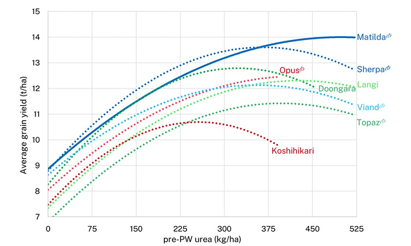
Source: NSW Department of Primary Industries and Regional Development, Rice Variety Guide 2025–26, Primefact 1112, 15th edition.
The average relationship between pre-PW urea application rate and grain yield for commercial rice varieties. Data was collected from 77 experiments across 10 seasons, covering all sowing methods and growing regions.
Pre-PW nitrogen and variable-rate application
Pre-PW is the most effective time to apply the majority of the crop’s nitrogen and address in-paddock variability. Use historical Dashboard imagery alongside available yield maps, cut-and-fill maps and other paddock data to identify areas that may require different rates.
Reducing nitrogen rates in stronger areas and increasing rates in weaker areas can help produce a more even crop and improve overall yield without increasing total nitrogen use.
Nitrogen timing methods and order of efficiency
Nitrogen efficiency varies significantly depending on application timing and method.
Pre-PW application: Urea drilled or spread onto dry soil before permanent water is the most efficient approach. In drill-sown crops, uptake efficiency improves as plant size and root development increase.
PI application: At PI, the crop has strong nitrogen demand and can take up nitrogen rapidly. However, PI nitrogen will only increase yield when crop nitrogen uptake* is below target or the crop is deficient. In most cases, applications above approximately 130 kg/ha of urea at PI provide limited economic return.
Mid-season application into water: Broadcasting urea into standing water is less efficient but may improve yield where earlier nitrogen applications were insufficient. Dashboard imagery can help identify nitrogen deficiency during the vegetative stage.
Application between flushes: Applying urea or GranAm between flushes in drill-sown systems is the least efficient option because drying soil increases the risk of gaseous nitrogen losses.
*Understanding nitrogen uptake at PI: Nitrogen uptake combines the crop’s nitrogen status and biomass. For Matilda, aim for a PI nitrogen uptake of at least 130, as measured through the Dashboard. A result below 130 indicates that pre-PW nitrogen may have been insufficient. PI nitrogen may improve yield, but the crop’s full yield potential may already be limited. Above a PI nitrogen uptake of 160, an economic response to additional nitrogen is unlikely.
Key takeaways
Get the foundations right first. More nitrogen will not compensate for poor establishment, ineffective weed control or other yield constraints.
Apply most nitrogen pre-PW, when it can be used most efficiently by the crop.
Use pre-PW variable-rate application to address known in-paddock variability.
Treat PI nitrogen as a top-up, not a replacement for insufficient early-season nitrogen.
Calculate kilograms of nitrogen applied per tonne of grain to assess efficiency and identify other factors that may be limiting yield.
Use the Dashboard to monitor crop timing, nitrogen status and variability throughout the season.
Additional resources