What is your rice stubble worth?
CY26 Annual Summary | Case Study
Planting a winter crop directly after rice harvest to take advantage of a full moisture profile is an integral part of many farming systems. In most cases, due to the high stubble loads of rice and the quick turnaround between rice harvest and winter crop planting, burning is considered the only option to get a timely winter crop in the ground.
There has been much work done on alternative uses of stubble; with the majority including baling and removal from the paddock. This can be an expensive operation that could delay winter crop planting and increase soil compaction.
Burning is under increasing scrutiny, with many regions of the world, including Australia, constrained by regulation and community expectations. Burning stubble also removes valuable nutrients and organic matter. If we could retain these high stubble loads, we could dramatically improve the structural integrity and enhance the long-term productivity of our heavy clay soils.
Nutrient components of rice stubble
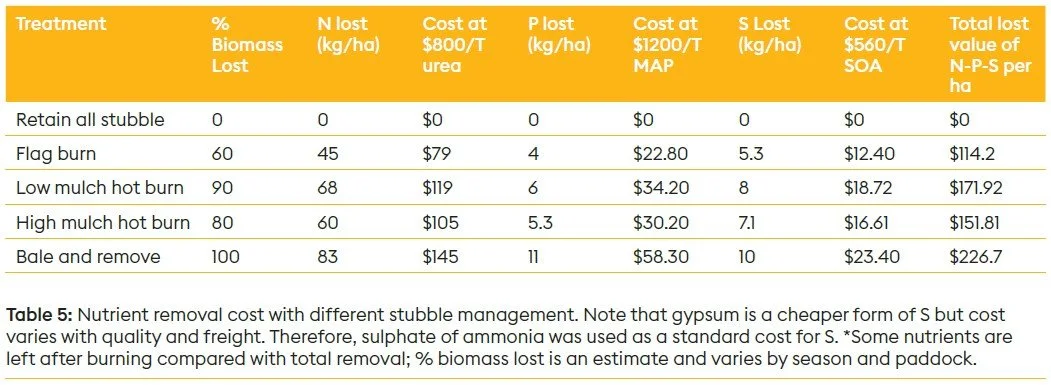
This article discusses the nutrient load in rice stubble and what we are losing by total removal such as through baling or mulching, burning to the ground, or even partial removal by flag burning or mulching high to retain some stubble. Its role is not to provide alternative methods to treat stubble at this stage, but rather to raise awareness of the value of stubble to our system. It is acknowledged that this nutrient load is not immediately available. Rather it contributes to the medium to long-term enhancement of soil chemical, biological and physical fertility.
During CY26, different stubble management practices were tested at Rice Research Australia Pty Ltd (RRAPL), along with samples collected from an Eastern Murray Valley (EMV) Focus Site. Based on a 13 T/ha rice crop yield, the following shows the estimates of how many kg/ha of nitrogen (N), phosphorus (P) and sulphur (S) is lost depending on the stubble management practice. The direct cost of each practice is based on an average price of $800/T for urea ($1.75/kg N), $1200 for MAP ($5.70/kg P) and $560 for sulphate of ammonia ($2.34/kg S).
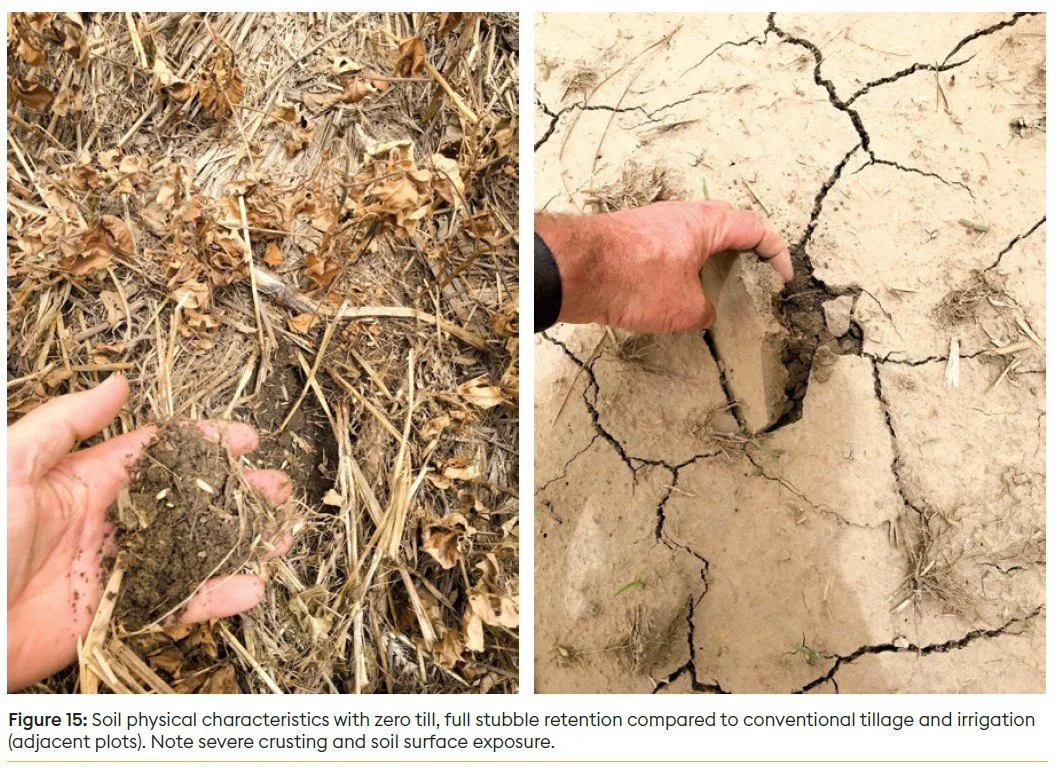
In addition, high organic loads retained in the system can cause dramatic improvements in soil structure and integrity. A ten-year study in India of a rice-wheat-legume, zero till system with full stubble retention achieved a 40% decrease in water use, decreases in greenhouse gas (GHG) emissions, energy requirements, lower weed seed bank and increases in nutrient availability. In addition, it demonstrated enhanced soil physical properties with an 80% increase in organic matter, 170% increase in microbial biomass and 40% higher overall system yields.
Many growers have already demonstrated the value of planting rice directly into legume cover crops and Rice Extension is currently working with Rice Research Australia to further demonstrate the value of a legume (vetch) cover crop while also trialling various products that enhance stubble breakdown.
Currently, Deakin University is doing some incredible research demonstrating that top yields can be maintained even when not flooding at any point of the crop’s lifecycle.
With this body of work and knowing the direct benefits from overseas long-term studies such as the example above, could a rotation of rice- wheat-legume cover crop-rice on our layouts with beds, high water flows, non-flooded culture be the future of our rice farming system?